Friday, November 6, 2009

"Strict Joy" Just O.K.


When I stepped into Starbucks on their Christmas-drink-debut to pick up my first beloved eggnog latte, I spotted The Swell Season's new album "Strict Joy," and was totally giddy.

I first became acquainted with this duo (Glen Hansard from the Irish band, The Frames and Marketa Irglova, a Czech classical pianist and vocalist) in the independent Irish film "Once," which premiered in 2007.

The two musicians collaborated before the films completion in writing and performing the entire soundtrack. The movie itself was, as Steven Spielberg put it, inspirational enough to last the rest of the year. As for the soundtrack, simply magical. I'm a big sucker for good harmonies and this soundtrack oozes them.

The musicians new album, composed under the name The Swell Season, falls comparably short. The songs lack the magic of the tunes featured in "Once," and I find the harmonies awkward. I enjoyed Irglova's lovely little voice so much in "Once," and was disappointed to find her drowned out by Hansard in their new album.

Irglovas vocals in "Feeling the Pull" and "In These Arms," are bothersome and insecure, but sweet in "Fantasy Man." Hansards vocals sound desperately poppy in "The Rain," a stray from his decidedly raspy/soulful folky sound, though redeem themselves with a catchy, climactic ending.

I really do enjoy some of the tracks, such as "High Horses," which features those interesting harmonies and Irglova's voice sounds brighter than in the rest of the album.

I'm sure if I give the album a few more listens I'll appreciate it more than I do now, I was just hoping for the near perfection found in "Once."

Monday, October 26, 2009

To every "Beardo" out there!


A friend of mine has been vigilantly nurturing his growing beard and posted a funny blog address on his twitter account that I'd like to share with you all - this girl is a crack-up. Check out her blog here.

I haven't the faintest idea how she can makes such sturdy and... beautiful (?) beards. Never thought to use "beautiful" in reference to beards, but it is evident she has incredible attention to detail and these synthetic beards will last you a lifetime!

Halloween costume addition, anyone?

what will they think of next?


Apple shocks me time and time again at their unconquerable ability to create stylish, beautiful electronics. The humble computer mouse is at last receiving first-class treatment!

Tuesday, September 8, 2009

WRITER'S BLOCK

writer's skyscraper - writer's Great Wall...I'm not sure what to call it, but I've got a bad case of it.

While in school I seemed to by flooded with interesting things to write about, but now I've got nothin'! It may be the fact that while at school I was painfully bored with my life half of the time and writing was my only interesting alternative. Now, however, I spend my days working, with Cameron and my sister and writing falls by the wayside. Sometimes a worn out girl just likes to sit on her bum and do nothing, okay! But doing nothing is counter-productive and doesn't prepare myself for a future of (cross-my-fingers) professional writing.

I tend to think someone needs money to do interesting things in order to have interesting things to talk about, but I hope this isn't true. If you have any free activities in the area to suggest I'd be grateful, for this cash-strapped college student is pinching pennies harder than she ever has before.

Saturday, May 23, 2009

Life in Limbo... Again?!?


Celebratebig.com

I've learned through living random spurts of my young life in Spokane that I cannot be simultaneously alone and at peace. Not totally at peace, that is. Of course I'm relaxed, though I can't escape feeling unsettled.

My disconnect to the rest of the world while I'm here is the element that strips me from total happiness. I can't seem to escape the images of old friends skipping about town arm-in-arm, snapping wide-smiling photographs to capture their carefree moments together. I've had a lot of moments like these with friends, though aren't all things lovely when admired in retrospect? Memories let in all the laughter without imperfections associated with a group of imperfect people: competition, passive-aggressiveness and selfishness. Despite social pressures, I'd much prefer plights of passive-aggressive competition among teenage girls than endure a weekend by myself. Oh the sacrifices of a having a social life, right?

A weekend all to yourself. Some may find the idea enticing, though the thought of keeping myself preoccupied all day is painful. Sure there are worst things in life, though it's 3 o'clock in the afternoon and all I have to show for it is a completed load of laundry, an unloaded-and-reloaded dishwasher, a few chapters of a book read, and three Facebook status updates. Oh, and this morning my Dad washed my last set of contacts down the sink (don't ask, my contact case is M.I.A.. I depended on one of Ikea's colorful plastic cups as a substitute).

As if being blind and alone isn't enough (over-dramatic? Yes. Though I bet you haven't spent nearly 48 hours in solitude) it's an absolutely gorgeous day outside. At least if it were raining I'd have half an excuse not to do anything with myself. My brother and I talked briefly about playing some tennis, until I remembered my recent loss of vision gives him a significant advantage.

In addition, this weekend is Seattle's Folklife, a congregation of young wanna-be hippies and pseudo-folkies sharing a love for ethnic foods, crappy to impressive local arts & crafts, and indie-folk music. Although the event is oftentimes a gathering place for pretentious young teens escaping their oppressive suburban upbringings, there's a fair share of interesting people worth meeting, plus the weather is always fabulous.

Folklife has, for the past couple of years, been my inauguration into summer; though this year will have to be missed. This is an entirely different story, as my laziness drove me to ride along with my Mom to the west side last week instead of driving my car, forcing me to leave with her a day before the festivities began to pick my car up.

So here I am, thinking of the fun I'll be missing out on. Being alone isn't as bad when you know others are just as bored as you are. It's selfish of me to wish boredom over my friends, though it's only fair!

Heck, if I can't have a fabulous time, have enough fun for the both of us. I feel like I'm the kind of person who always gets gipped in the fun department, and for this I've created an official Summer To-Do List, so when Fall comes around I won't feel like I missed out on anything. It gives me a goal, a game plan.

Once I make a to-do list, it must be completed. Thus, my first item can be checked: Write Something.

Friday, April 24, 2009


Today my friend Colleen and I were enjoying some heavy indie beats in the car, occasionally adding our own sounds to the chaos when it dawned on us: we've entered a musical era, which in some ways, parallels Modern Art movements.

The goal of Modern Art movements such as Impressionism, Post-Impressionism, Fauvism, etc. was to create an emotional experience for the viewer. The art wasn't as concerned about the subject matter, but the spiritual effects it had upon the viewer while contemplating art. That profound experience became the goal of the artists, and they experimented with any style available to them in order to accomplish this.

Whenever my mom and I get in the car, whether to drive across the state or hop in the car for a quick cup of coffee, I bring with me a stack of CDs along for the ride. Every time, without fail, my mom pokes fun at the empty lyrics. "Now what in the world does (insert empty lyric) mean?" "...I don't know? But isn't it a great song?" I reply.

But what makes them great? I realize as she repeats the words I never thought to really listen to them before, but why? The musicians accomplished creating such unique and powerful instrumental sounds, words became unnecessary in evoking the emotions they were trying to convey to their listeners. Fast and upbeat instrumentals energize, while more slow tunes cause the listener to become reflective, or relaxed.

However, I have a strong aversion to music with a catchy tune, but paired with pathetically weak lyrics whose lines repeat an intoxicating number of times (think "Stanky Leg"). I have a difficult time enjoying the song despite how entertaining the beats may be, as the irritating loop of words seems copy-and-pasted onto my subconscious for the next few hours.

Of course there are mainstream exceptions. I've contemplated the deep words of artists like Benjamin Gibbard, Conor Oberst and Sufjan Stevens (and there are no doubt hundreds more musicians who can actually write), but a disturbingly larger fan base has established for musicians known for catchy tunes, while the annoying words paired with the beats are ignored.

Will the music world ever be revamped to its former glory of the turbulent '60s and 70s, when young and adult alike found refuge in the revolutionary words of Bob Dylan, John Lennon, or Paul Simon? Will songs really fighting for something flood the worlds speakers again, or are we cursed to hear ones like "Soulja Boy," or "Hot N Cold," on eternal repeat?

Wednesday, April 22, 2009

I'D LIKE TO DO SOMETHING UNUSUAL...


...For Once

You know what's genius? Hairdryers with those retractable cords installed in them. That alteration became a solution to the most aggravating part of the hair-drying process; how many times have you tightly wrapped the long cord around the neck of the hairdryer only to have it unwind on itself? Inventions like these prompt us to ask ourselves, "Why didn't I think of that?"

I used to look at a Mondrian (those simplistic, modern paintings made of primary-colored squares and rectangles separated by simple black lines), and say, "I could totally make that. How is this art?" I've critically gazed at a piece by Van Gogh and noted, "That can't be very hard. I could probably do that and this guy's considered an artistic genius."

The more I learn about the context behind hugely popular artistic movements the more I ask myself, "could I have thought of something like that?" and the less sure I become of my ability to create works as balanced, or conversely, dissonant as the seemingly simple pieces done by Mondrian or Van Gogh. It takes a great mind to conceive something genius and organic that sways from what's familiar, which prompts my next question. How can you think outside of the box when you're locked inside? You can't find an escape because you're so caught up about how you're inside the box thinking of anything outside of it is impossible; only when you forget you're inside the confines of the box will you find a way out of it.


André Breton (pictured above), the "Pope of Surrealism," built the foundation of this movement from a moment that occurred as described above. When he lay in bed about to sink into sleep, a strange sentence leapt in his mind; this sentence was: 'A man is cut in half by the window.' He became mesmerized by this simple sentence as it seemed to breed independently, from his subconscious. He lay there visualizing the man standing upright, walking with a window "perpendicular to the axis of his body," (Breton, Le Manifeste du Surréalisme, 1924). Breton imagined the window around his waist secured from him leaning out of a window then straightening up again.

He decided to incorporate this unusual sentence and mental image into something poetic, and was surprised that as he began to write, a series of sentences equally compelling followed. Breton shared these findings with a French writer, activist and Dadaist (another artistic movement which came before Surrealism, though embodied some similar theories of irrationality in art), Philippe Soupault. They decided to exercise the finding by writing automatically: quickly, without meditation, and found their works to show shocking similarities.

"...in both cases there was the illusion of an extra-ordinary verve, a great deal of emotion, a considerable assortment of images of a quality such as we would never have been capable of achieving in ordinary writing, a very vivid graphic quality, and here and there an acutely comic passage," (Breton, Le Manifeste du Surréalisme, 1924).

Thus Surrealism was born, an artistic and literary movement which shook the Art world and continues to inspire artists today; and all bred chiefly out of a revelation. I say "chiefly," because though the strategies employed by Surrealists, such as Automatism, were organic, the idea of trusting irrationality over human logic was not. This is when understanding the context of artistic movements is important, as one must examine the state of the world in comparison to the movements which came out of it to better grasp the artists perspectives.

Just a year before the Surrealist Manifesto was published, the Allied powers signed the last peace treaty that marked the finish of WWI. People across the world were appalled at the devastation caused by WWI and at the mere fact that humans were capable of such wreckage, especially to each other. Out of this disgust, people began to wonder why we depend on human reason, which was proved by WWI as flawed. Surrealism was an escape from human reason to something deeper and more authentic, unharmed by imperfect rationale.

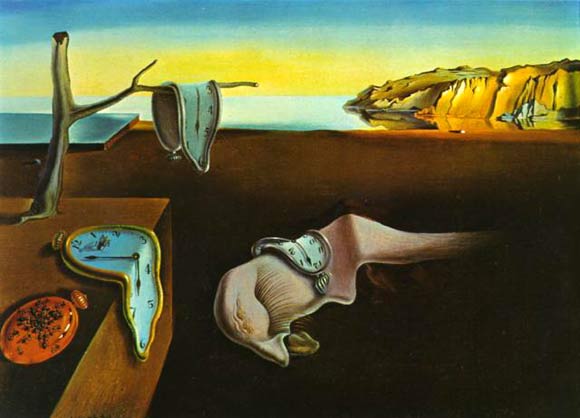
This irrationality was harnessed through strategies such as Dali's "paranoiac-critical Method" in which he created scenes that were distorted, though painted with such precision the viewer would contemplate that it could represent reality. This is seen in his famous piece, "Persistence of Memory,” where the lines were painted and blended with such precision, the strange subject matter seems almost feasible.

Although Surrealism was unique (in many ways) from anything that came before it, the movement has stirred confusion in its viewers for different reasons than other Modern art movements. With Surrealism, many people were simply confused about what was being represented in the art works, less than the earlier noted response of, "I could do that." Those involved in the later movements, such as De Stijl and Abstract Expressionism, were met frequently with this response, (mostly from those who looked at the art instead of what the art represented).

The De Stijl movement came shortly after the Surrealist movement and was also a response to WWI; however, De Stijl trusted human rationale and rested in the utopian ideal of finding a universal balance and harmony in art, which would be projected onto the viewer’s life. As Piet Mondrian's art encompassed, this harmony would be achieved by using only the purest colors (primary: red, blue and yellow, as well as black and white), and the simplest lines (vertical and horizontal). Though the paintings appear easy to do, Mondrian would work and re-work his paintings until he felt they were absolutely balanced, that if it were placed on a point at the center of the artwork, it wouldn't tilt in any direction. Though his work is highly minimalistic, once put into context they are quite lovely; I especially enjoy his “Composition with Red, Yellow and Blue.”

All of my life, when placed before a Jackson Pollock I would cringe, and note to myself, "Why Pollock, how edgy of you. You threw paint on a canvas and called it art." Though, big surprise, I was ignorant to what Pollock was trying to accomplish with his art and in what context. Again, the theme arises that what art was doing means much more than the art in and of itself. Pollock was creating art amidst the events of the Cold War, the United States was aggressively campaigning Democratic ideals of freedom and liberation, and it’s hard not to look at a painting done by Pollock without feeling a sort of unshackling. As my art history teacher noted, though many people assume what Pollock did was simple; no one has been able to replicate what Pollock did.

Let us examine his work more closely, take "Number One" for example. There exist clear patterns of movement in his work, and deliberate layering of color. There are no focal points in his work, so when people view the art, their eyes are constantly moving about the canvas. There is simply no place to rest your eyes. Accomplishing this is an artistic science, one Pollock did in a totally provocative way.

Thus, I ask myself: will my "Ah-ha!" moment ever come, or are they secured for a handful of extraordinary people? The most difficult part of this meditation is knowing that I have to stop searching for my moment if I want to find it. Instead, I've got to continue doing the things that I love and hope I'll be tormented by a "A man is cut in half by the window" moment one of these nights too.


Photograph of Andre Breton: http://www.leninimports.com/andre_breton_gallery_5.jpg.